In all my years of working on European projects, I have never experienced the subject of a project changing so fundamentally in such a short period of time as in the case of YouthGovAI.
Since we started our project, the public discourse on artificial intelligence has changed considerably. I have illustrated this development below using a selection of newspaper articles. However, this reflects how I personally have perceived the discourse. I have not conducted a systematic, data-driven discourse analysis (in fact I began one using a nice tool. And then I was like “What am I doing, I do not have time for this.”), although I would imagine that many people would share my assessment.
The following reflections are based on a talk I gave at the Berlin Climate Education Conference, “Out of the Box!”, in October 2026. As part of a plenary session on AI in climate education, I shared some of our experiences from YouthGovAI and reflected on how the rapidly changing AI landscape challenges our work as educators.
How the public discourse on AI has changed
2023 – Fascination with the technology
In 2023, shortly after ChatGPT was released, we mainly talked about large language models. We marvelled at what they could do and speculated about all the things they might change.
The Guardian, 2023: AI likely to spell end of traditional school classroom, leading expert says
2024 – Users, misuse and AI literacy
In 2024, we increasingly talked about the users of these models. Various risks came into focus, particularly how this technology could be misused and by whom. We also discussed how we, as users, could become less vulnerable to things like fake news and disinformation.
The Guardian, 2024: ‘Disinformation on steroids’: is the US prepared for AI’s influence on the election?
2025 – The environmental costs of AI
From 2025 onwards, the focus increasingly shifted towards the enormous costs for the climate, the environment and local communities, particularly those associated with data centres.
AI was no longer just an abstract technology operating somewhere in the cloud. It was becoming increasingly tangible.
The Guardian, 2025: AI could account for nearly half of datacentre power usage ‘by end of year’
2026 – Resistance, actors and power structures
In 2026, we have increasingly been talking about resistance to data centres. In this context, the actors involved and the underlying power structures have come into sharper focus.
The German newspaper Süddeutsche Zeitung captured this development particularly well: with the construction of data centres around the world, AI has acquired something resembling a face. Something tangible that people can oppose.
The Guardian, 2026: In first, California city overwhelmingly votes to permanently ban datacenters.
What are the environmental costs of AI?
Let us briefly look at data centres, as they constitute the material foundation of the AI revolution.
Data centres are enormous warehouses filled with thousands, sometimes tens of thousands, of server racks. A single server rack is roughly the size of a large refrigerator, yet its power consumption can be enormous, particularly when it is equipped with the latest AI hardware.
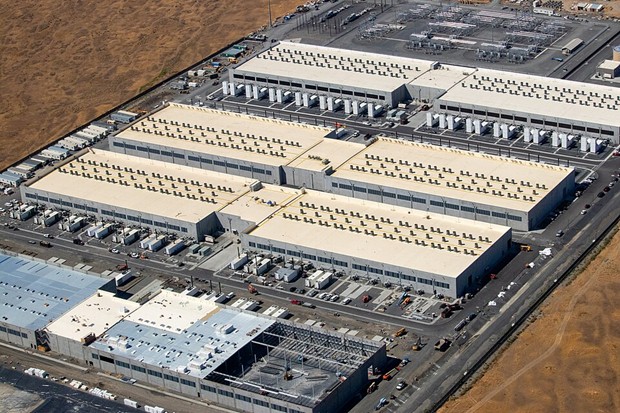
Image by to Tedder Lizenz CC-BY-SA 4.0 ↩︎
In the United States, data centres already accounted for 4.4% of total electricity consumption in 2023. By 2028, this figure could reach 12%, illustrating the enormous scale of the expansion of data centre infrastructure.
These server racks generate considerable amounts of heat and are often cooled using water. The water consumption of large data centres can be comparable to that of entire towns.
According to a United Nations report, by 2030, data centres could:
• Consume more than 945 TWh of electricity per year.
• Account for almost 3% of global electricity consumption.
• Consume roughly twice as much electricity as France does today.
• Rank sixth worldwide in terms of electricity consumption if data centres were a country.
According to the same report, data centres could be responsible for around 400 million tonnes of CO₂ equivalent emissions in 2030, more than the UK’s annual greenhouse gas emissions
However, there is another significant problem. A study published in Nature, has modelled how AI-driven productivity gains could affect global emissions. Its findings suggest that the application of AI in the fossil fuel sector alone could, depending on the scenario, generate between three and thirteen times more emissions than all of today’s data centres worldwide. So, we add in effect between three and thirteen times the emissions of the UK’s annual greenhouse gas emissions ON TOP!
But energy is not the only problem. There is also the issue of electronic waste, which is expected to increase considerably as a result of the AI boom. One reason for this is the enormous competitive pressure and the fear of missing out (FOMO): companies need to have the latest technology and the latest chips.
Furthermore, the AI boom is driving the use of so-called forever chemicals (PFAS), which are used, among other things, in semiconductor manufacturing and cooling systems. The problem is that exposure to certain PFAS is associated with serious health risks, including certain cancers, liver damage and elevated cholesterol levels.
And they are, as their name suggests, practically forever. Many of these substances hardly break down and can accumulate in the environment and food chains.
Beyond the direct environmental impact
There are, however, further indirect environmental consequences of the AI boom.
For example, some of the major technology companies are beginning to reconsider their climate commitments. And although these commitments are voluntary, this development gradually undermines our broader societal commitment to climate neutrality.
We are also eroding the norm of transparency. In 2024, lobbying by the technology industry contributed to the incorporation of confidentiality provisions into EU regulations on data centres. As a result, individual consumption figures can be treated as commercially confidential, limiting the public’s ability to scrutinise the environmental impact of data centres.
The German government has also proposed relaxing certain energy efficiency requirements for data centres.
Decarbonisation is coming under pressure, too. Fossil fuels play a significant role in supplying the energy needed for the expansion of data centres. And once fossil fuel infrastructure has been built, it is likely to remain in place for decades, with economic interests in keeping it operational.
Beyond the environmental impact, there are numerous other risks associated with AI that need to be taken seriously, as the work of renowned research institutions and international organisations demonstrates:
- Technofeudalism: Increasing concentration of economic power in the hands of a few technology corporations, raising concerns about the emergence of technofeudal structures. (OECD, 2025)
- Aggravation of the climate crisis through rising energy demand and the risk of fossil fuel lock-in. (IEA, 2025)
- Increased risks of military escalation, including nuclear conflict, and the potential misuse of AI in the development of biological weapons. (SIPRI, 2025)
- Risk of losing human control over increasingly autonomous AI systems. (International AI Safety Report, 2026)
- Increasing risk of large-scale AI-enabled cyberattacks on critical infrastructure. (International AI Safety Report, 2026)
Reduced engagement in critical thinking and the potential gradual erosion of human skills and competencies through overreliance on AI. (Microsoft Research & Carnegie Mellon University, 2025)
What does this mean for YouthGovAI?
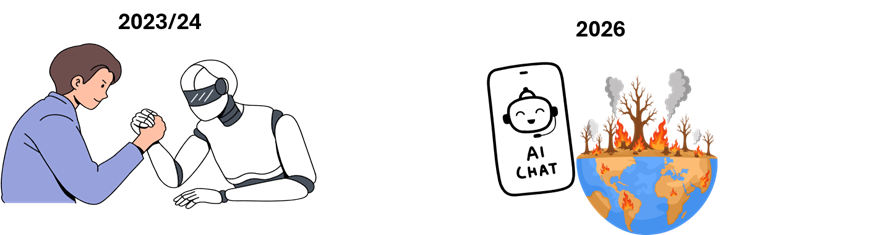
Against this backdrop, our project has had to adapt to a rapidly changing public discourse and to a changing understanding of what AI governance actually entails.
In 2024, we were still primarily asking ourselves questions such as:
• How do we deal with AI?
• How does AI work?
• What are the risks?
• How can we empower young people to use AI critically and responsibly?
In 2026, we increasingly find ourselves confronted with much more fundamental questions:
• Do we want all of this?
• What do we want instead?
• And how can we get involved in shaping these developments?
The questions we asked in 2024 are, of course, still relevant. But they are no longer sufficient.
Empowering young people in the age of AI must mean more than enabling them to understand and use the technology. It must also mean enabling them to participate in the societal and political decisions that determine how this technology is developed, deployed and governed.
And perhaps this is the most important development we have witnessed over the course of our project.
Holger Haberstock
References and further reading
Environmental impact and resource consumption
• Hanwha Data Centers (2025). What Are the Power Requirements for AI Data Centers?
• Congressional Research Service. Report R48646 – Data centres and resource consumption.
• United Nations University – Institute for Water, Environment and Health (2026). The Environmental Cost of AI.
• npj Climate Action (2026). Study on AI-driven productivity gains and CO₂ emissions.
• The Guardian (16 September 2026). Data centres, electronic waste and pollution.
• The Guardian (14 September 2026). PFAS and the AI industry’s growing demand for forever chemicals.
Climate commitments, transparency and energy policy
• The Guardian (2 April 2026). Google, AI data centres and their environmental impact.
• The Guardian (17 April 2026). Microsoft and US technology firms lobbying the EU for confidentiality rules on data centre emissions.
• CORRECTIV (8 October 2026). Rechenzentren boomen: Bundesregierung will Umweltvorgaben lockern (Data centres are booming: German government wants to relax environmental requirements).
• International Energy Agency (2026). Modernising Grids in the Age of Electricity: The Need for Modern Grids.
Broader societal and security risks
• OECD (2025). Competition in Artificial Intelligence Infrastructure.
• International Energy Agency (2025). Energy and AI: Energy Supply for AI.
• Stockholm International Peace Research Institute (2025). Artificial Intelligence, Non-proliferation and Disarmament: A Compendium on the State of the Art.
• International AI Safety Report (2026). International AI Safety Report 2026.
• Microsoft Research & Carnegie Mellon University (2025). The Impact of Generative AI on Critical Thinking: Self-Reported Reductions in Cognitive Effort and Confidence Effects From a Survey of Knowledge Workers.
