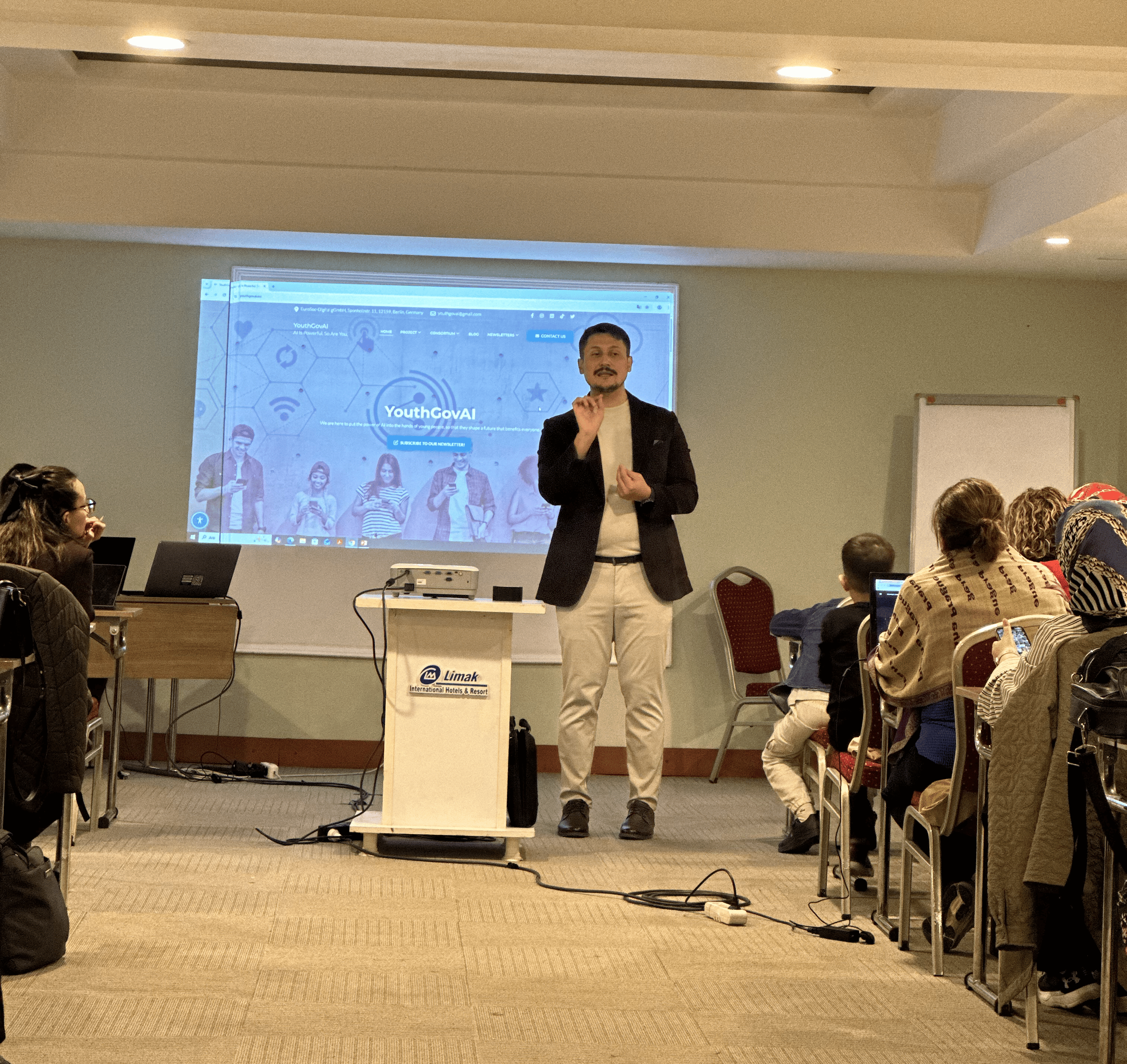
The 16th eTwinning National Conference took place in Antalya from December 9 to 11, 2025. Supported by the EU Commission and the Ministry of National Education in Türkiye, the event featured several AI trainers and digital technology critics from across the country. Ahmet Göçen from Genc STEM Association, was invited to speak on the topic of AI ethics and teacher training.

During the seminar, he introduced our YouthGovAI/ Erasmus Plus project—dedicated to empowering youth in the governance of Artificial Intelligence—and delivered a training session for teachers focused on the intersection of AI, human cognition, and ethical frameworks.
The following are his notes from his seminar on AI ethics, which pertains to both teachers and students, the target groups of our YouthGovAI Project.
The Blue Pill vs. The Red Pill: The Cognitive Cost
The digital revolution is no longer a distant future; it is in our classrooms, at our desks, and increasingly, within our decision-making processes. But is this symbiotic relationship with AI enhancing our potential or diminishing our innate abilities? Is this a case of a blue or red pill?
Research highlighted during our training shows that students who rely on AI-generated summaries remember approximately 22% fewer core concepts a week later compared to those who take their own notes.

While AI reduces unnecessary cognitive load, it also removes “desirable difficulties,” potentially weakening our mental “muscles”. This can lead to “solution paralysis”—a state where individuals feel stuck or experience high anxiety when forced to work without technological assistance.
Can Machines Truly Think?
This question has been at the heart of AI since Alan Turing’s seminal 1950 paper, Computing Machinery and Intelligence. While modern models like GPT-4.5 and LLaMa-3.1 have now passed the Turing Test experimentally—with GPT-4.5 being identified as human by 73% of participants—the debate continues.
John Searle’s “Chinese Room” argument reminds us that following a massive rulebook to process symbols is not the same as true understanding. AI may simulate intelligence through vast scaling, but does it truly possess meaning?
The Ethical Compass: How Does AI Decide?
Ahmet Göçen also shared results from a comparative study conducted by his research group in Türkiye, involving 208 teachers and various LLMs (ChatGPT, Grok, and DeepSeek). The findings revealed a fascinating gap after his research group analyzed the responses to a set of ethical dilemmas provided by AI models and teachers.
- AI Consistency: LLMs produced highly similar results based on utilitarian and Rawlsian perspectives.
- Human Complexity: Teachers displayed “ethical pluralism,” making decisions that were more sensitive to context and human nuance, especially in controversial dilemmas like strikes or after-school assistance.
This reinforces the idea that the “human touch” remains indispensable in education; LLMs should facilitate, not replace, human decision-making. That is why we always highlight human agency in our YouthGovAI training framework.
Becoming “Aidemic”: The Path Forward
The fear of technology is not new; in 1986, math teachers famously protested the use of calculators in classrooms. However, the goal of YouthGovAI is to move beyond resistance toward a symbiotic relationship. To navigate this era, we must embrace the “Aidemic” identity, as his research group found in another study.
- High AI Literacy: Demonstrating a deep understanding of AI concepts.
- Ethical Navigation: Addressing biases and ethical concerns in AI use.
- Symbiosis: Using AI as a facilitator while keeping human expertise, emotions, and critical thinking at the center.
Conclusion
AI may be faster at making decisions, but the best outcomes are achieved when humans and AI work together with a calibrated balance of trust. We must avoid over-reliance—where we follow AI suggestions blindly—and under-reliance, where we ignore its potential benefits due to fear.
As we continue our work with YouthGovAI, we remember that while AI is our most powerful tool, the compass remains in our hands. The youth should have a significant voice in this field, as they will shape the future with this powerful tool. They should possess academic skills and critical thinking to develop both themselves and AI.
